
/ KNOWLEDGE · SOURCING
Plastic Junction Box: What to Specify Before You Order
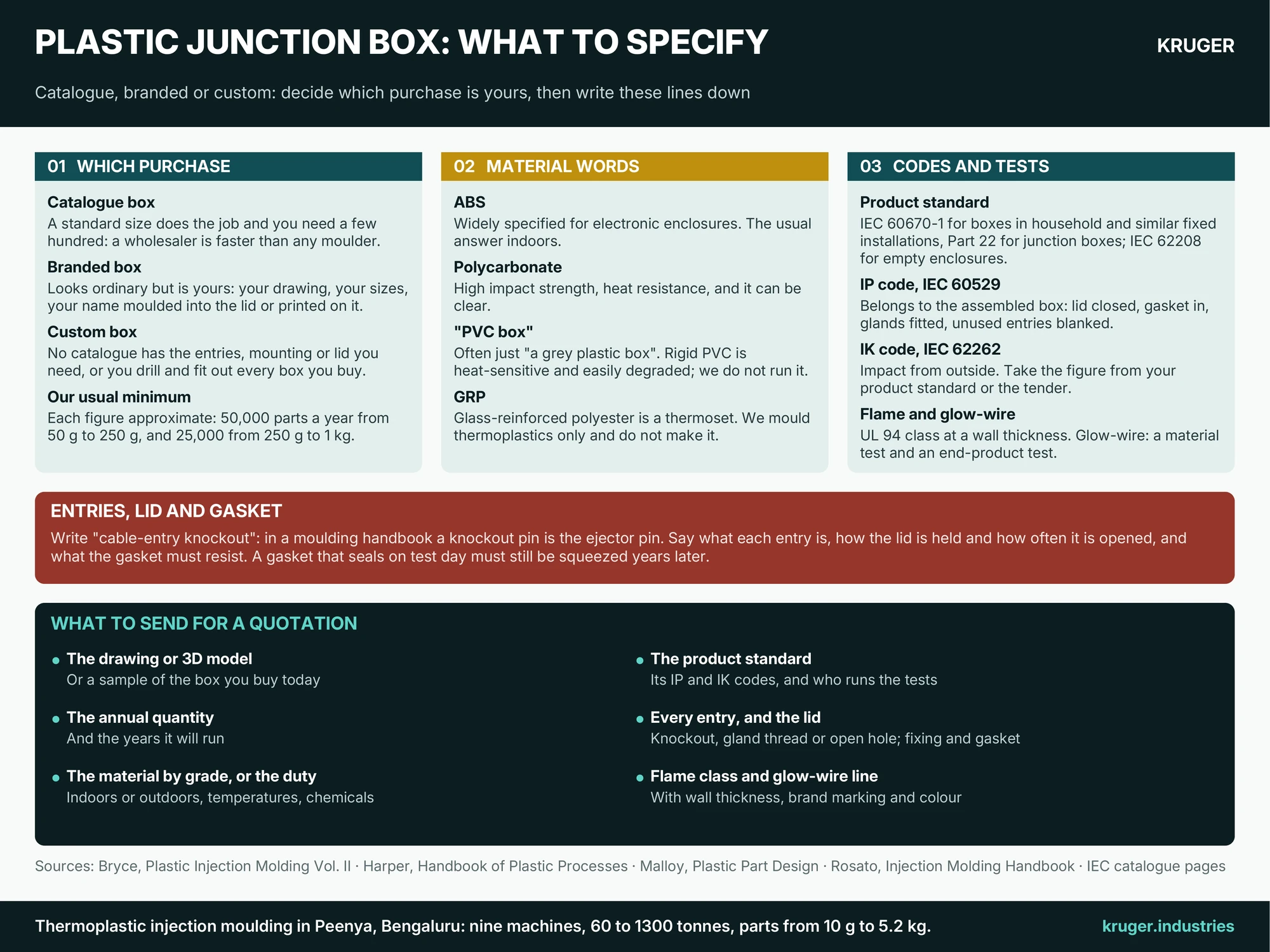
A plastic junction box is two different purchases under one name: a catalogue box bought by the carton, or a box moulded to your own drawing and brand on a tool you pay for. Kruger sells the second: we mould to a customer’s design on customer-funded tooling and keep no catalogue or stock. Gasket grooves, inserts and tolerances are in our enclosure specification guide.
Catalogue box, branded box or custom box
A catalogue box is the right buy when a standard size does the job and you need a few hundred. A wholesaler will serve you faster than any moulder.
A branded box looks ordinary but is yours: your drawing, your sizes, your name moulded into or printed on the lid.
A custom box earns its tool when no catalogue has the entries, mounting or lid you need, or you drill and fit out every box you buy; our custom enclosure guide finds the break-even quantity. Our minimum order page prints our usual minimum, each figure approximate: 50,000 parts a year for a part of 50 g to 250 g, and 25,000 for one of 250 g to 1 kg.
The material words buyers use
- ABS. Widely specified for electronic enclosures. The usual answer indoors.
- Polycarbonate. High impact strength, heat resistance, and it can be clear. For sunlight, see our ABS and polycarbonate comparison.
- “PVC box”. Often just “a grey plastic box”. Rigid PVC is a real box material, but it is heat-sensitive and degrades easily in processing, and we do not run it.
- GRP. Glass-reinforced polyester is a thermoset, usually shaped by lay-up, spray-up or hot-press moulding of sheet compound. It is a different process family from the thermoplastic injection moulding we do, and we do not make it. A glass-filled thermoplastic is a different material, so “GRP or equivalent” needs your engineer’s agreement.
Name the product standard first
Two IEC standards cover most of these boxes. IEC 60670-1 gives the general requirements for boxes and enclosures for electrical accessories in household and similar fixed installations, and its Part 22 adds the particular requirements for connecting boxes, which is the standard’s name for a junction box. IEC 62208 covers the empty enclosure a panel builder later fits out with switchgear and controlgear. Write the one your tender calls for, and check which edition is in force.
The IP code belongs to the assembled box
IEC 60529 defines the IP code and its tests. They are run on an enclosure, never on a bare moulding, so the code describes the box as installed: lid closed, gasket in, glands fitted, unused entries blanked.
- A catalogue box keeps its printed code only while its entries are closed as its maker tested them. A hole drilled on site makes it your own untested box.
- For a custom or branded box, write the code your product standard names, who runs the test, on how many assembled samples, and who pays.
The IK code: the knock it must survive
IEC 62262 classifies an enclosure’s protection against outside mechanical impact, as an IK code. It applies only where your equipment’s standard calls for an impact degree, so take the figure from that standard or the tender. Plastics are less forgiving when cold, so give the lowest site temperature.
Knockouts and gland entries
In a moulding handbook a knockout is part of the mould: Rosato’s glossary gives “knockout pin” as another name for the ejector pin. On your drawing it is the thin disc a fitter breaks out for a cable, so write “cable-entry knockout”.
Say what each entry is: an open moulded hole, a knockout, a threaded gland entry, or a plain wall to drill later. Give the gland thread, the number of entries on each side, and whether unused ones must stay sealed for the IP test. Side-wall entries usually need moving cores in the mould, and each adds to the tool.
Lid fixing and gasket
Say how the lid is held and how often it is opened: screws into moulded bosses or metal inserts, a hinge, or a snap-on lid. Malloy’s part-design text adds that a screwed joint keeps the plastic under constant compression, and the design must allow for that force relaxing over a long service life. A gasket that seals on test day must still be squeezed years later.
Enclosure seals range across silicones, urethanes and other compounds according to the duty, and some must resist solvents, acids or alkalis as well as moisture. Name the duty, then ask whether the gasket is a loose ring or a bead dispensed onto the lid, and who fits it.
Flame and glow-wire: two lines, not one
The flame line is a UL 94 class at a stated wall thickness, a property of the resin grade on its maker’s datasheet; our UL 94 guide explains the classes. IEC 60695-2-12 tests standard specimens of the material and gives its glow-wire flammability index. IEC 60695-2-11 is the test on the end product. The datasheet carries only the first; your product standard asks for the second. We run the grade you name and send its maker’s certificate; the end-product test and any listing stay with you.
What to send for a plastic junction box quotation
- The drawing or 3D model, or a sample of the box you buy today.
- The annual quantity and the years it will run.
- The material by grade, or the duty: indoors or outdoors, temperatures, chemicals.
- The product standard, its IP and IK codes, and who runs the tests.
- Every entry: knockout, gland thread or open hole, side by side.
- The lid: fixing, how often it is opened, and the gasket.
- The flame class with its thickness, the glow-wire line, your brand marking and colour.
Send the list through our RFQ page. A partner toolroom builds the tool to our design, and it remains your property. Our electrical enclosures page lists the boxes, covers and glands we mould. If your volume points to a catalogue box, we will say so.
Sources quoted: D. M. Bryce, Plastic Injection Molding, Vol. II: Material Selection and Product Design Fundamentals (Society of Manufacturing Engineers, 1997); C. A. Harper (ed.), Handbook of Plastic Processes (Wiley, 2006); R. A. Malloy, Plastic Part Design for Injection Molding (Hanser, 1994); D. V. Rosato, D. V. Rosato and M. G. Rosato (eds), Injection Molding Handbook, 3rd edition (Kluwer Academic Publishers, 2000). Standards named, each described in our own words from its publisher’s catalogue page: IEC 60529 (1989, amended 1999 and 2013), Degrees of protection provided by enclosures (IP Code); IEC 62262:2002, impact protection of enclosures (IK code); IEC 60670-1:2024, boxes and enclosures for electrical accessories, general requirements; IEC 60670-22:2024, particular requirements for connecting boxes and enclosures; IEC 62208:2023, empty enclosures for low-voltage switchgear and controlgear assemblies; IEC 60695-2-11:2021 and IEC 60695-2-12:2021, glow-wire tests. Check the edition your own specification cites.