
/ KNOWLEDGE · SOURCING
Plastic Battery Box: What to Specify Before You Order
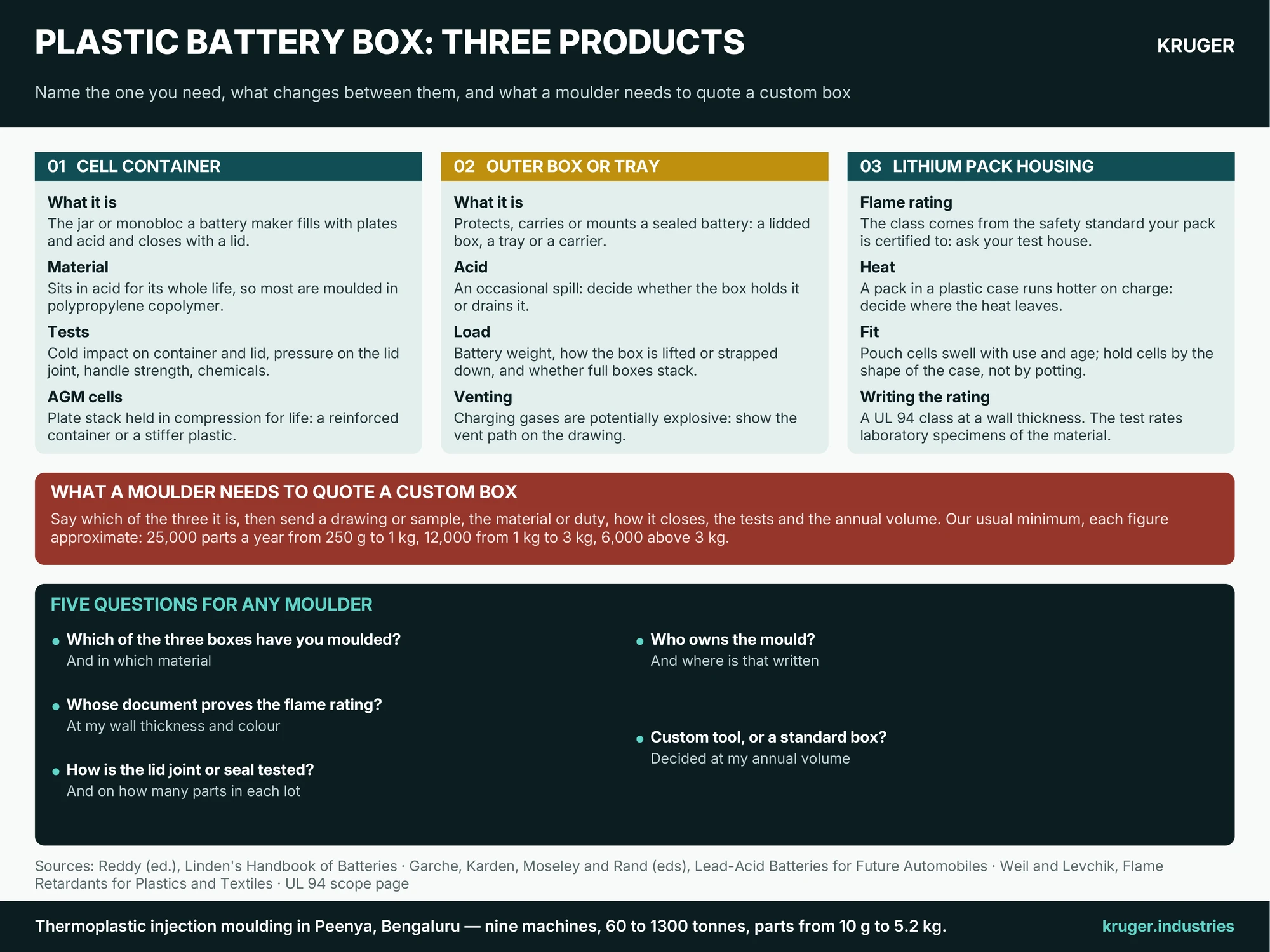
“Plastic battery box” is one search for three different products, and an enquiry that does not say which one costs both sides a week of questions. It can mean the container that holds the plates and acid of a lead-acid cell, an outer box or tray that carries a finished battery, or the housing of a lithium pack. Each asks something different of the plastic. This page helps you name yours and send a moulder what it needs to quote a custom box on a tool you fund.
A fair warning first: a custom box needs its own mould, and a mould must be spread over thousands of parts a year. For a few boxes for a boat, a caravan or a home solar bank, a stockist’s standard box is the right buy.
1. The cell container: the box that is part of the battery
This is the jar or monobloc that a battery maker fills with plates and sulphuric acid and closes with a lid. The plastic sits in acid for its whole life, which is why most are moulded in polypropylene copolymer. The handbook on automotive lead-acid batteries edited by Garche, Karden, Moseley and Rand lists the tests that follow: impact on container and lid at low temperature, a pressure test on the joint between container and cover, handle strength in the cold, and resistance to chemicals. An absorbent-glass-mat cell adds a load from inside: its plate stack is held in compression for life, so the container is reinforced or moulded in a stiffer plastic. What belongs on the drawing is in our container specification guide; why the part is hard to mould is in our container moulding guide.
2. The outer box or tray: it carries a finished battery
Here the battery is already sealed, and the box protects, carries or mounts it: a lidded box on a vehicle, a tray under a rack, a carrier with handles. Acid contact is now an occasional spill, so decide whether the box holds a spill or drains it. For load, state the weight of the battery, how the box is lifted or strapped down, and whether full boxes stack. Linden’s Handbook of Batteries describes the gases a lead-acid battery gives off on overcharge as potentially explosive, so the box must breathe: show the vent path on the drawing.
3. The lithium pack housing: flame rating and heat come first
A lithium housing holds no free acid, so three other things lead. The first is flame rating: the same handbook says container materials should be chosen with their flammability in mind, and that safety agencies may require flame-retardant materials. The class you need comes from the safety standard your pack is certified to, so ask your test house before you ask a moulder. The second is heat: a pack closed in a plastic case runs hotter on charge than the same cells without a case, so decide where the heat leaves. The third is fit. Pouch cells swell with use and age and need room, and holding the cells still by the shape of the case, not by potting, costs more in tooling and saves labour later.
How to write the flame rating
Weil and Levchik’s handbook on flame retardants names blends of polycarbonate and ABS, widely flame-retarded with halogen-free phosphates, as typical for equipment housings that must reach V-0. It also warns that heavy loadings of flame retardant make polypropylene brittle. Polycarbonate brings impact strength but poor chemical resistance, so a polycarbonate housing blend is not a substitute for polypropylene in an acid container. Write the rating as a class at a wall thickness. UL 94, the UL standard for flammability tests of plastic materials, rates laboratory specimens, and its own scope treats the result as a first screen, leaving acceptance to the finished equipment. Check the current edition; our UL 94 guide explains the classes. The one flame-retardant grade we run today is a UL 94 V-2 polypropylene copolymer. A V-0 grade is trialled on your part, with the resin maker’s certificate on file, before we quote it.
What a moulder needs to quote a custom box
- Which of the three it is, and the battery or cells it holds, with their weight.
- A drawing or STEP file, or a sample box with its lid.
- The material by grade, or the duty: acid contact, flame class at your wall thickness, outdoor use, colour.
- How it closes: a heat-sealed lid, a gasket with fasteners, or a loose vented lid, and the protection against dust and water you must meet.
- The tests it must pass, and who runs them.
- Annual volume and the first delivery date.
A custom box runs on a mould that you fund. Ours are designed by Kruger, built by partner toolrooms and proved on our machines, and the tool stays your property. Our usual minimum follows part weight, each figure approximate: 25,000 parts a year from 250 g to 1 kg, 12,000 from 1 kg to 3 kg and 6,000 above 3 kg. The reasoning is in our minimum order quantity guide. We mould thermoplastics, in parts up to 5.2 kg, and we do not make steel enclosures.
Five questions for any moulder
- Which of the three boxes have you moulded, and in which material?
- Whose document proves the flame rating at my wall thickness and colour?
- How is the lid joint or seal tested, and on how many parts in each lot?
- Who owns the mould, and where is that written?
- At my annual volume, is a custom tool sensible, or should I buy a standard box?
Our battery containers page lists what we mould: cell and monobloc containers, lids, and thermoplastic parts for lithium packs. Send the drawing, the battery it holds, the material or the duty, and the annual volume through our RFQ page or the contact page. An engineer replies within 48 hours on working days, and says so plainly if a standard box suits you better.
Sources quoted: T. B. Reddy (ed.), Linden’s Handbook of Batteries, 4th ed. (McGraw-Hill, 2011); J. Garche, E. Karden, P. T. Moseley and D. A. J. Rand (eds), Lead-Acid Batteries for Future Automobiles (Elsevier, 2017); Edward D. Weil and Sergei V. Levchik, Flame Retardants for Plastics and Textiles (Hanser, 2016); A. B. Morgan and C. A. Wilkie (eds), The Non-halogenated Flame Retardant Handbook (Scrivener/Wiley, 2014); V. Goodship (ed.), Practical Guide to Injection Moulding (Arburg / Rapra Technology, 2004); UL Standards & Engagement, UL 94, the standard for flammability tests of plastic materials for parts in devices and appliances, scope page.