
/ KNOWLEDGE · MATERIALS
Polycarbonate injection moulding — a buyer’s guide
Polycarbonate is hard, rigid and extremely impact resistant, and it can be transparent, which is why it appears in housings, protective covers and light-transmitting parts. It is also a material that punishes a loose process: moisture, moulded-in stress and chemical contact each turn up later as a defect or a field failure. Arburg describes polycarbonate (PC) as extremely impact resistant over a very wide temperature range, with low creep and stable dimensions, and Bryce adds excellent heat resistance and transparency. This page covers what to specify, how PC behaves in the machine, where it fails in service, and five questions for any moulder. It follows our materials guide.
Which polycarbonate?
Kulkarni warns that a variety of PCs is on the market and that processing can differ so widely that the processing temperatures of two PCs may not even overlap. A drawing that says only “polycarbonate” lets the moulder change grade, and so the process and the part, from one order to the next. Name the grade and ask for its datasheet; our guide to reading a plastics datasheet shows what to look for, and working ranges are in the temperature chart. Resin lots matter as well: Kulkarni shows viscosity curves for several lots of one polycarbonate grade, with the lots differing most at low injection speeds and converging at high ones.
Water: a small amount, a large effect
Arburg puts the moisture absorption of PC at no more than 0.5%, which sounds modest. But absorption is rapid, and for processing the material may carry only 0.02% at most; above that the mould fills less well and the part shows waviness. Kulkarni’s table of suggested maximum moisture lists polycarbonate at about 0.02%, and he names splay as the common cosmetic fault when moisture is present. Arburg calls pre-drying absolutely essential and wants the granules kept dry until they reach the screw, recommending heated hoppers or dry conveying.
The books disagree on drying time: Arburg gives 8 to 14 hours, Kulkarni about 3. That is a good reason to ask a moulder for the moisture reading rather than the hours. Our guide to drying plastics covers the equipment.
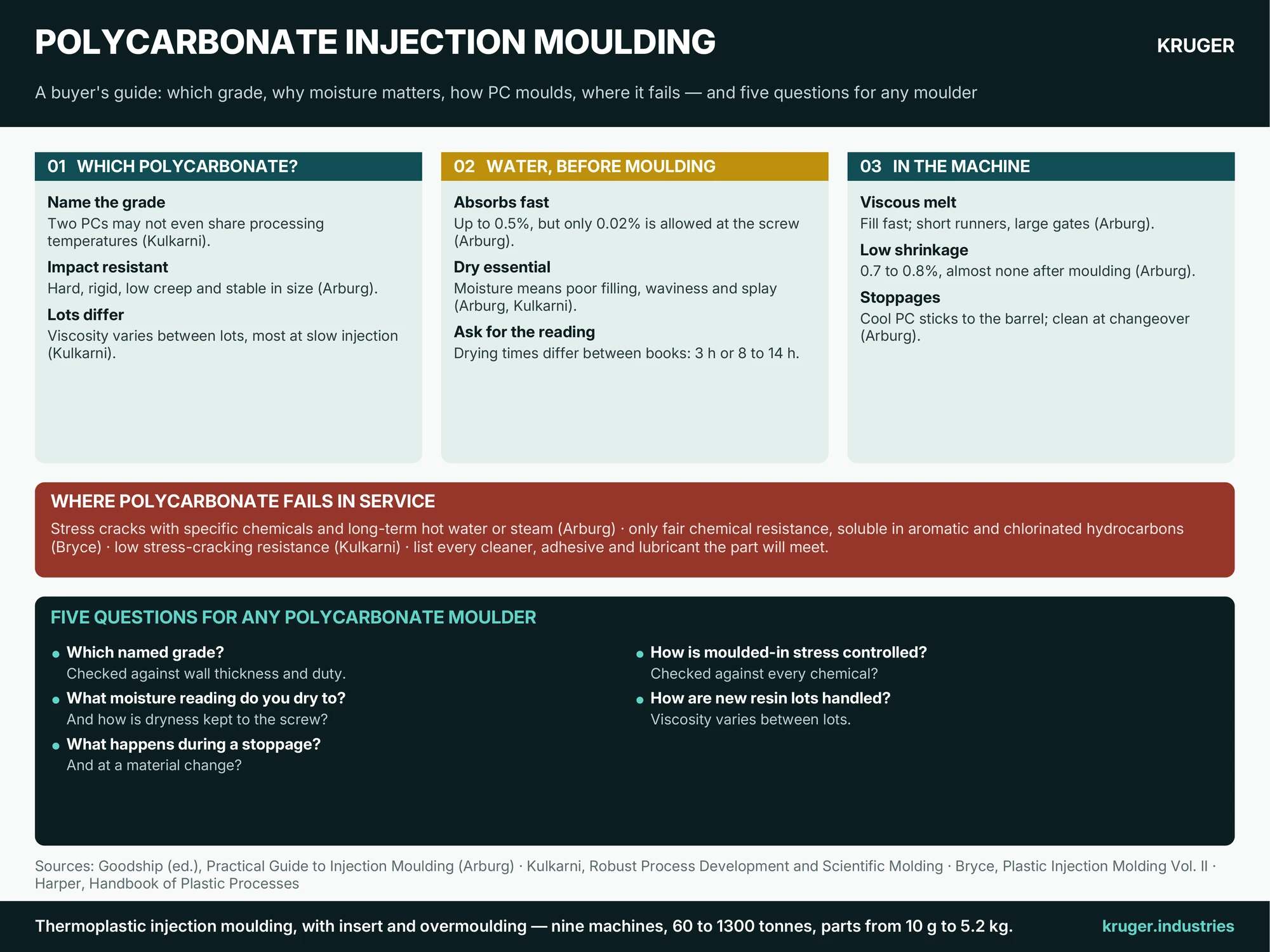
How polycarbonate behaves in the machine
- A viscous melt. Arburg says filling responds more to a rise in temperature than to more pressure, asks for injection speed as high as possible, and wants short runners and gates of large cross-section. It gives injection pressures of 800 to 1,600 bar.
- A hot mould. Arburg notes that high mould temperatures improve flow and reduce the risk of internal stresses. The range is in our temperature chart.
- Low shrinkage, little orientation. Arburg gives 0.7 to 0.8% in the flow direction and almost the same across it, with practically no after-shrinkage; Harper lists 0.005 to 0.007 in/in. In Bryce’s tolerance table PC sits with the tighter-tolerance materials: 0.28 mm preferred over 152 mm, the same as ABS and well inside polypropylene’s 0.66 mm.
- Overheating. Arburg warns that thermal damage discolours the material and cuts impact resistance.
- Stoppages and changeovers. If production is interrupted, Arburg says to bring the cylinder temperature well down, because cool PC adheres strongly to the cylinder wall. Barrel, screw and nozzle need thorough cleaning at a material change, or dark particles detach from the heat-damaged layer on restart and spoil parts. See our guide to purging and changeovers.
Where polycarbonate fails in service
Arburg lists the susceptibilities: stress cracks with specific chemicals, and long-term damage from hot water and steam. Bryce rates chemical resistance as only fair and notes that PC is soluble or partly soluble in aromatic and chlorinated hydrocarbons; Kulkarni also gives low stress-cracking resistance. Moulded-in stress from fast packing or a cold mould combines with chemical contact, so the buyer’s job is to list every substance the part will meet, including cleaners, adhesives and lubricants, and to read our guide to environmental stress cracking before approving a design. Bryce and Arburg both call PC self-extinguishing in part; that is a description, not a rating, as our UL 94 guide explains.
Five questions for any polycarbonate moulder
- Which named grade, and has the datasheet been checked against the part’s wall thickness and duty?
- What moisture reading do you dry to, how is it measured, and how is the material kept dry up to the screw?
- What happens to the cylinder during a stoppage, and how is it cleaned at a material change?
- How are moulded-in stresses controlled, and has the part been checked against every chemical it will meet?
- How are new resin lots handled, given that viscosity varies between them?
Send the part drawing and the duty it must survive, and we will go through these questions with you.