
/ KNOWLEDGE · WRITING THE RFQ
The injection moulding RFQ — what to send to get a quote worth having
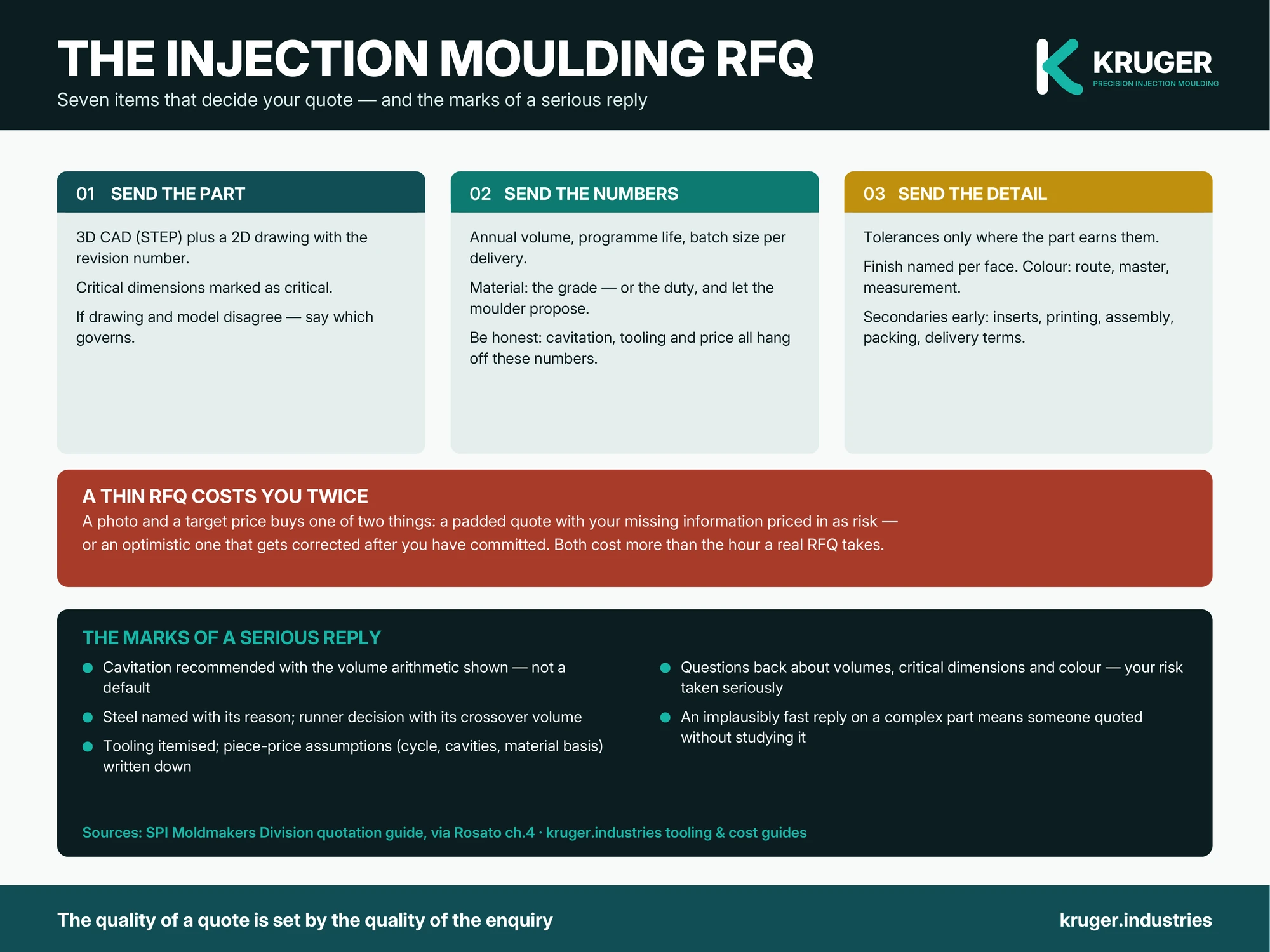
The quality of a quote is set by the quality of the enquiry. Send a moulder a part photo and a target price and you will get one of two things back: a padded number with your missing information priced in as risk, or an optimistic number that gets corrected after you have committed. Both cost you more than the hour it takes to write a proper RFQ. This guide lists what that hour should produce — and what a serious reply looks like, so you can judge the moulders who answer.
The industry wrote the checklist decades ago
Estimators have always needed the same facts. The Society of the Plastics Industry’s Moldmakers Division published a standard quotation request form — reproduced in Rosato’s handbook — and its fields are a buyer’s education in one page: part drawings with revision numbers, number of cavities, mould type and construction, cavity and core steel, finish grade, special features such as hot runners, and the press the tool must fit. Every field exists because a quote written without it is a guess. The form is old; the information it demands has not changed.
The seven items that decide your quote
- The part, unambiguously. 3D CAD (STEP preferred) plus a 2D drawing carrying the revision number and the critical dimensions marked as critical. If the drawing and the model disagree, say which governs.
- The material — or the duty. Name the grade if your product is certified around it. Otherwise state what the part must survive — load, temperature, chemicals, outdoors — and let the moulder propose; our guide to reading a plastics datasheet shows how to judge the proposal.
- Volumes, honestly. Annual quantity, expected programme life, and batch size per delivery. Cavitation, tooling class and piece price all hang off these three numbers — inflate them and the tool you buy will be wrong for the programme you actually run.
- Tolerances only where the part earns them. A drawing with one general tolerance block invites either over-pricing or under-engineering. Our tolerances guide explains the honest grades.
- Surface finish, named. An SPI grade or a texture reference, per face — not an adjective. The surface finish guide shows why this is a tooling decision you pay for once.
- Colour, specified. Route, master standard and measurement method — the subject of our colour guide. “Black” is not a specification.
- Everything after moulding. Inserts or overmoulding, printing, assembly, packing spec, delivery terms and destination. Secondary operations quoted late always cost more than secondary operations quoted early.
What a serious reply looks like
Judge the answers you get against a simple standard: everything recommended should arrive with its arithmetic. The cavitation proposal with the volume calculation shown, not a default. The steel named with its reason. The runner decision with its crossover volume. A tooling price itemised, and a piece price whose assumptions — cycle, cavities, material price basis — are written down, because an assumption you can read is an assumption you can challenge. Our tooling guide and the six cost drivers explain each line you should expect to see. And a reply that arrives implausibly fast for a complex part deserves suspicion, not celebration: someone who has not studied your drawing is quoting someone else’s.
What you do not need to have solved
An RFQ is not an exam. You do not need to have chosen the cavitation — that is the moulder’s calculation to show you, as the cavities guide explains. You do not need a finished design: flag what is still moving, and a competent moulder will review the part against the design-for-mouldability rules and come back with cost-saving changes while change is still cheap. The one thing you cannot delegate is honesty about volumes and priorities — nobody can quote well around numbers you have rounded up for negotiating comfort.
The questions a serious moulder asks you back
The reply that should worry you is the one with no questions in it. A moulder who intends to hold a price will first pin down what it depends on: which dimensions are truly critical, how firm the volumes are, what the part mates with, how colour will be judged, who approves first samples and against what. Questions in the reply are the sound of your risk being taken seriously — their absence usually means it has been priced in, or ignored.
Send it here, if you like
This page is the standard we ask of our own enquiries. Send the seven items — or as many as you have — and an engineer replies within 48 hours on working days, with the arithmetic shown. Request a quote.