
/ KNOWLEDGE · MATERIALS
ABS vs Polycarbonate Enclosures: Indoor, Outdoor and UV
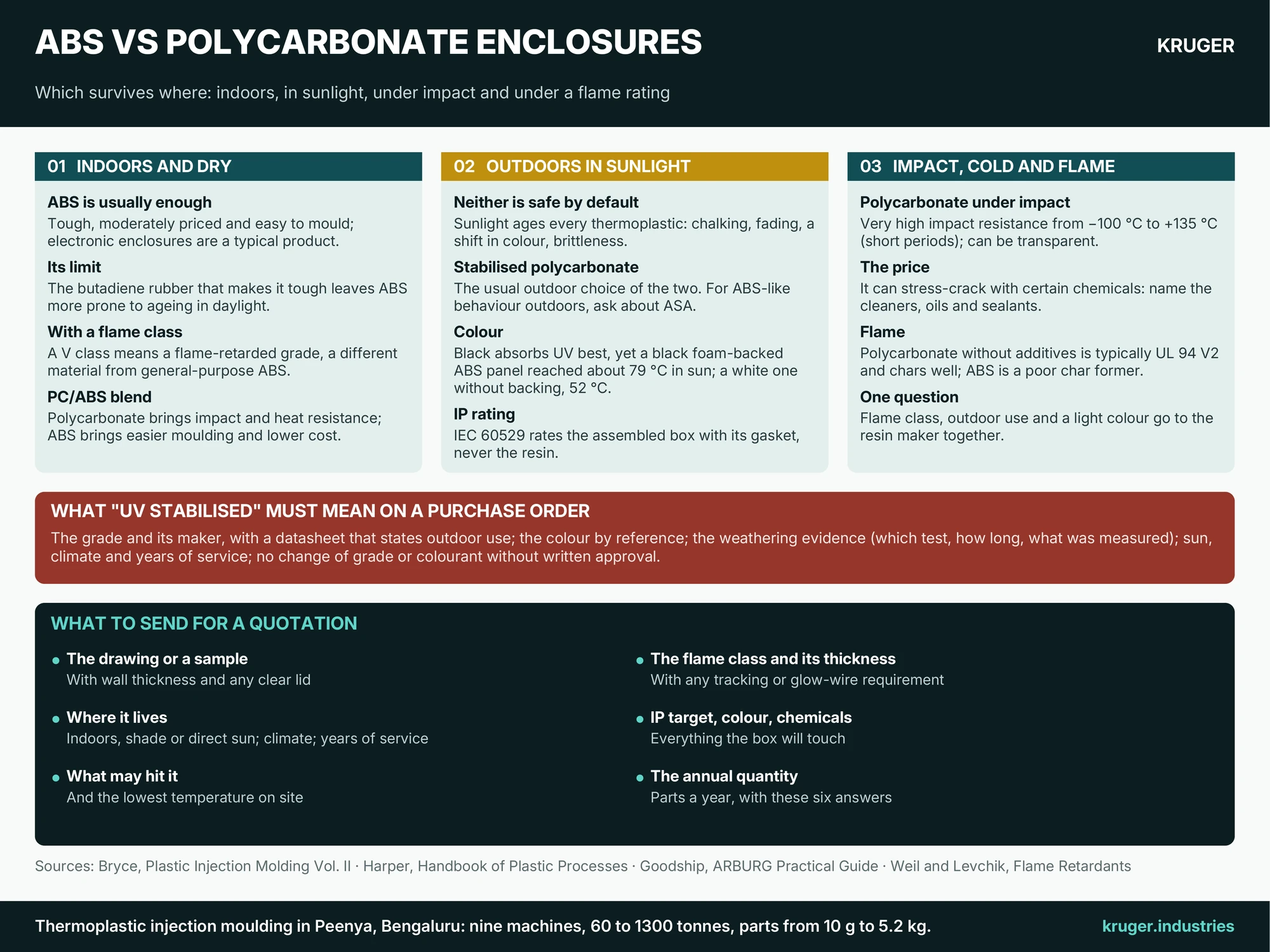
An ABS vs polycarbonate enclosure choice is settled by where the box will live, not by which plastic is better. We mould both: see our ABS guide and our polycarbonate guide. They part company in sunlight, under a blow and in a flame test. This page takes each in turn, then says what “UV stabilised” must mean on a purchase order and what to send so the right grade is quoted the first time.
Indoors and dry: ABS is usually enough
ABS is one of the main engineering plastics: tough, moderately priced and easy to mould, and electronic enclosures are among its typical products. For a controller housing or a wall box in a plant room that is a sound, economical answer. Its limit comes from the ingredient that makes it tough: the butadiene rubber leaves ABS more prone to ageing than plain polystyrene. Indoors, away from windows, that seldom matters. In daylight it does.
Outdoors in sunlight: neither is safe by default
Sunlight ages every thermoplastic. The signs are chalking, fading, a shift in colour and, in the end, brittleness. Resin makers offer UV-resistant versions of most materials, which slow the damage without ending it. A standard grade of either plastic is therefore an indoor grade. Of the two, stabilised polycarbonate is the usual outdoor choice, in our view because it starts with more toughness and more heat margin to lose. Outdoor signs show the usual answer: a sheet with ABS underneath for strength and a thin skin of UV-stabilised polycarbonate or acrylic on top for weatherability. The ABS is kept out of the sun.
If a box needs ABS-like behaviour outdoors, ask about ASA, a relative of ABS made for weatherability, with similar mechanical properties. Colour matters too. Bryce calls black “the most effective UV absorber”, and also reports outdoor tests in which a black, foam-backed ABS panel reached about 79 °C in direct sun while a white panel without the backing reached about 52 °C. A black box shields its resin and heats its contents; a light one runs cooler and leans harder on the stabiliser.
Under impact and in the cold
The Arburg guide credits polycarbonate with very high impact resistance from −100 °C to +135 °C, the range it gives for short periods, and lists housings and protective covers for electrical units among its uses. It can also be transparent, which ABS cannot. For a box at kerb height, on a vehicle or with a clear lid, that settles the matter. The price is chemical sensitivity: polycarbonate can stress-crack in contact with certain chemicals, so tell the moulder which cleaners, oils and sealants the box will meet (see our stress cracking guide).
Under a flame rating
Weil and Levchik’s flame-retardant handbook gives polycarbonate without additives a typical UL 94 rating of V2. Polycarbonate is a good char former and ABS a poor one, so an ABS enclosure that must carry a V class will be a flame-retarded grade, a different material from general-purpose ABS. The additive can change the weathering as well: one long-used bromine additive for styrenic plastics tended to yellow in sunlight and so went mainly into painted or dark parts. Flame class, outdoor use and a light colour must be put to the resin maker as one question.
The common middle path is a PC/ABS blend, in which the polycarbonate brings impact and heat resistance and the ABS brings easier moulding and a lower cost. Our UL 94 guide explains the classes.
IEC 60529, the IP code, classifies the protection an enclosure gives, so it is the assembled box with its gasket that earns the rating, never the resin; our enclosure specification guide lists what the drawing needs. UL 746C covers parts made of polymeric materials in electrical equipment and the tests used to evaluate them. If your product is certified to UL standards, ask which evaluations the exact grade and colour carry.
What “UV stabilised” must mean on a purchase order
The two words alone bind nobody. Bryce notes that a UV absorber is added at about 1 per cent by weight and is used up as the plastic ages, so the phrase promises a longer life, not immunity. Write these instead:
- The grade and its maker, with a datasheet that states outdoor or UV-stabilised use.
- The colour, by reference, because the pigment is part of the protection.
- The weathering evidence: which test, natural or accelerated, for how long, and what was measured afterwards.
- The service: whether the box faces the sun, in which climate, and the life expected there.
- No substitution: no change of grade or colourant without your written approval.
If you asked for a “PVC box”
Rigid PVC is a genuine enclosure material that suits outdoor exposure, but it degrades easily at moulding temperatures and not every moulder runs it. Often, though, “PVC box” is trade shorthand for any grey plastic box. Say whether PVC is a requirement or a habit; if a habit, the conditions above choose the material.
What to send for a quotation
- The drawing or a sample, with wall thickness and any clear lid.
- Where it lives: indoors, outdoors in shade or in direct sun, the climate, and the years of service expected.
- What may hit it, and the lowest temperature on site.
- The flame class and its thickness, with any tracking or glow-wire requirement from your product standard.
- The IP target, the colour, and the chemicals the box will touch.
- The annual quantity.
Our electrical enclosures page shows what we mould for panel builders and equipment makers. Send us the drawing with these six answers, and our reply will name the grade we would quote, and say why.
Sources quoted: D. M. Bryce, Plastic Injection Molding, Vol. II: Material Selection and Product Design Fundamentals (Society of Manufacturing Engineers, 1997); C. A. Harper (ed.), Handbook of Plastic Processes (Wiley, 2006); V. Goodship (ed.), ARBURG Practical Guide to Injection Moulding (Rapra Technology, 2004); Weil, E. D. and Levchik, S. V., Flame Retardants for Plastics and Textiles, 2nd ed. (Hanser, 2016). Standards named: IEC 60529, Degrees of protection provided by enclosures (IP Code); UL 746C, Polymeric Materials, Use in Electrical Equipment Evaluations.