
/ KNOWLEDGE · MATERIALS
Battery container material: PP, ABS or SAN?
The right battery container material is decided by the cell that goes inside it, not by the moulder’s habit. A flooded monobloc, a valve-regulated battery and a stationary cell whose electrolyte level must be read through the wall ask three different things of the plastic, and the answer also fixes how the lid is joined. This page compares polypropylene copolymer, ABS and transparent SAN; the drawing itself is covered in our battery container specification guide.
Flooded monoblocs and traction cells: polypropylene copolymer
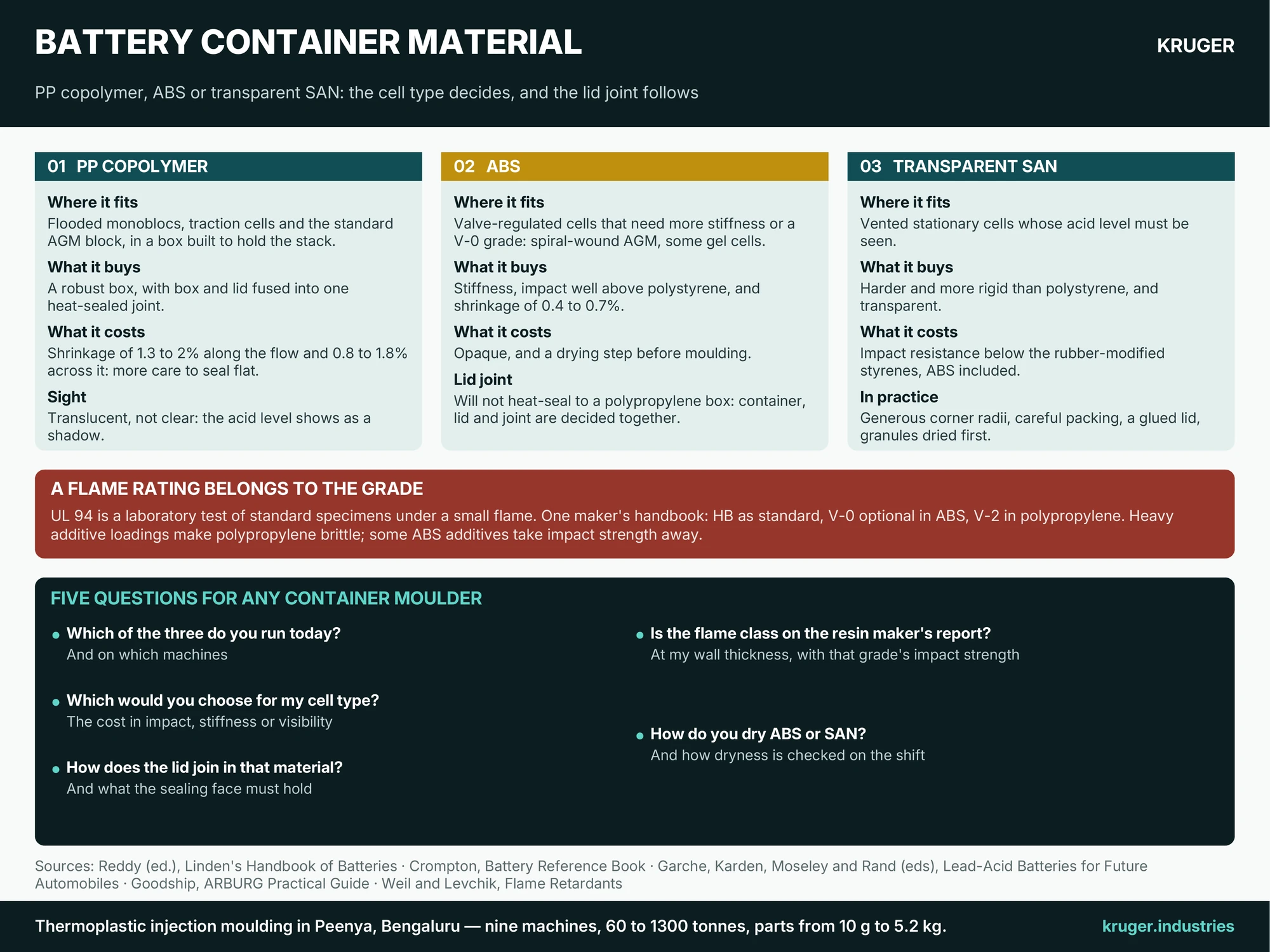
Crompton’s battery reference book records the move from hard rubber cell boxes to polypropylene and gives two reasons: the plastic box is more robust, and box and lid can be fused into one heat-sealed joint. That joint is the main thing polypropylene buys, with the acid resistance and cold impact that our battery container guide and polypropylene guide explain.
What it costs is shrinkage and sight. Goodship’s Arburg guide puts the processing shrinkage of polypropylene at 1.3 to 2 per cent along the flow and 0.8 to 1.8 per cent across it, against 0.4 to 0.7 per cent for ABS, so a deep polypropylene box takes more care to seal flat. Natural polypropylene is also translucent, not clear: the acid level shows as a shadow, which suits a monobloc but not a standby cell.
Valve-regulated batteries: stiffness first
An AGM plate stack must stay squeezed for the life of the battery. The AGM chapter of the automotive lead-acid volume edited by Garche, Karden, Moseley and Rand describes two ways a container holds that pressure, reinforcement designed into the box or a stiffer plastic, and notes that the spiral-wound design goes into ABS because it is tougher still. The standard AGM battery it describes is still a polypropylene box, designed to hold the stack. Gel cells load the walls differently: one European maker’s stationary-battery handbook explains that slight pressure inside a gel cell, or slight vacuum after a long rest, makes large walls bulge or draw in. That maker’s gel ranges use polypropylene for most of the larger blocks, and ABS for the smallest blocks and for its tubular-plate gel cells.
Where polypropylene is not stiff enough, ABS buys stiffness, impact and flat faces. Goodship rates its impact resistance well above polystyrene’s, and its low shrinkage keeps a sealing face true. It costs transparency, since its butadiene makes it opaque, and a drying step before moulding. It also changes the lid joint. Linden’s handbook records that most starter batteries and many traction cells are fusion-sealed, while stationary batteries in plastic cases are closed with epoxy glue or solvent cement. An ABS lid will not heat-seal to a polypropylene box, so container, lid and joint method are decided together.
Stationary cells: when the level must be seen
Linden lists the usual containers of vented stationary cells as transparent thermoplastics, among them SAN, polycarbonate, PVC and ABS (standard ABS is opaque), with translucent polyolefin for some small types. Crompton gives the reason: through a transparent container the acid level and condition of a standby cell can be checked from outside.
SAN, styrene-acrylonitrile, is the clear member of the styrene family. The Arburg guide describes it as harder and more rigid than polystyrene and able to be transparent, with impact resistance below the rubber-modified styrenes, ABS included. That is the bargain: walls a technician can read like glass, paid for in toughness. A SAN container wants generous corner radii, careful packing and a glued lid, and the granules must be dried first, because moisture shows as waviness in the moulding.
A flame rating belongs to the grade
UL 94, from Underwriters Laboratories, is a laboratory test of standard specimens under a small flame. Its scope calls the result a preliminary indication and leaves final acceptance to the finished equipment’s own standard; check the current edition before citing it. The European maker’s handbook shows how this lands on containers: its standard housings carry the basic HB class, with V-0 offered as an option in ABS and V-2 in polypropylene.
Weil and Levchik’s handbook on flame retardants explains the difference. Polypropylene burns much like a hydrocarbon fuel and leaves little char, and heavy additive loadings make it brittle. ABS can be compounded to V-0 with brominated additives, some of which also take impact strength away. One flame-retardant grade runs here today, a UL 94 V-2 polypropylene copolymer for valve-regulated containers and covers; we do not claim V-0. Our UL 94 guide shows how to read a rating.
What to state in the enquiry
- Cell type: flooded monobloc, traction cell, AGM, gel or vented stationary.
- Visibility: transparent, translucent or opaque, and the colour.
- Lid joint: heat-sealed or glued, with container and lid in one material.
- Flame class: the UL 94 class and wall thickness, as a material rating on the resin maker’s report.
- Wall loads: stack compression or internal pressure, and the lowest handling temperature.
- Grade: a named grade, if you have one.
Five questions for any container moulder
- Which of the three materials do you run in production today, and on which machines?
- For my cell type, which would you choose, and what does it cost me in impact, stiffness or visibility?
- How does the lid join in that material, and what must the sealing face hold?
- Is the flame class on the resin maker’s report at my wall thickness, and what is the impact strength of that grade?
- How do you dry ABS or SAN, and how is dryness checked on the shift?
Polypropylene copolymer containers and covers run here today; see our battery containers and covers page. ABS is moulded here too and is quoted against your drawing. Transparent SAN is not on our published materials list, so ask before you assume it. Send the drawing with the cell type, the material or grade, the lid joint, the flame class and the annual volume, and we will quote tool and piece, or say plainly what does not fit.
Sources quoted: T. B. Reddy (ed.), Linden’s Handbook of Batteries, 4th edition (McGraw-Hill, 2011); T. R. Crompton, Battery Reference Book, 3rd edition (Newnes, 2000); J. Garche, E. Karden, P. T. Moseley and D. A. J. Rand (eds), Lead-Acid Batteries for Future Automobiles (Elsevier, 2017), chapter 6 by J. Albers and E. Meissner and chapter 20 by R. D. Prengaman and A. H. Mirza; a European stationary-battery manufacturer’s Handbook for Stationary Lead-Acid Batteries, Part 1, edition 3 (2008); V. Goodship (ed.), Practical Guide to Injection Moulding (Rapra Technology and ARBURG, 2004); E. D. Weil and S. V. Levchik, Flame Retardants for Plastics and Textiles, 2nd edition (Hanser, 2016); UL 94, Tests for Flammability of Plastic Materials for Parts in Devices and Appliances, edition 7 (UL Standards and Engagement, 2023).