
/ KNOWLEDGE · READING DATASHEETS
How to read a plastics datasheet — what the numbers promise, and what they don’t
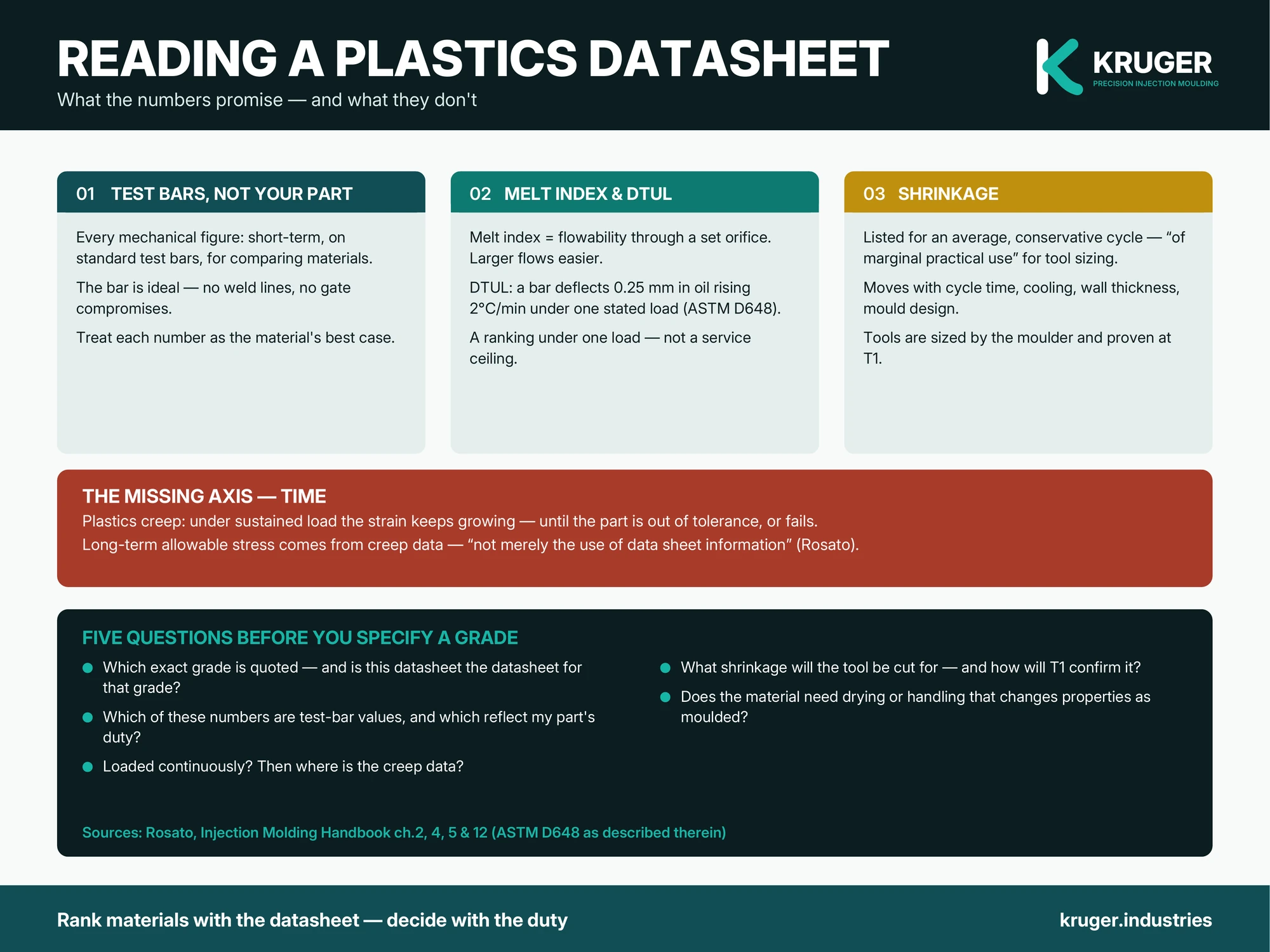
The most misread document in plastics purchasing is the material datasheet. Two grades are compared, the bigger numbers win, and a part is specified around figures that were never a promise about the part at all. The correction comes from the standard literature and fits in one sentence: datasheet mechanical properties are short-term values measured on standard test bars, intended for comparative evaluation — for ranking materials against each other, not for predicting what your part will do for ten years (Rosato). Read with that sentence in mind, a datasheet is a genuinely useful document. This guide walks the numbers a buyer actually argues about.
Test bars are not your part
Every figure was produced on a moulded specimen designed to be ideal: uniform section, unbroken flow, no weld lines, no gate compromises. Your part has all of those — they are what the design-for-mouldability rules and the wall thickness guide exist to manage. The supplier states properties “based on test bar information,” and the moulder’s job is to convert the material into a part that approaches them (Rosato). So treat every datasheet number as the material’s best case, achieved under conditions your geometry will not fully reproduce.
The flow number — melt index
Melt index expresses “flowability”: how much material passes through a set orifice under controlled conditions, with larger values meaning easier flow (Rosato). Buyers meet it when thin walls or long flow paths are in play. What the single number cannot tell you is the whole moulding story — flow behaviour belongs to the moulder’s process window, and choosing a grade on melt index alone optimises the machine’s afternoon, not your part’s service life. Ask the moulder which grade they would run for your geometry, and why.
The temperature number — DTUL/HDT
The deflection temperature under load — also called heat distortion temperature — is a precisely defined laboratory event: a standard bar, three-point loaded at a stated bending stress, oil bath rising at 2 °C per minute, and the recorded temperature is the point where the bar has deflected a quarter of a millimetre (ASTM D648, described in Rosato). It is “a method to guide or assess a plastic’s load-bearing capacity at elevated temperatures” — a ranking under one specific load, not a service ceiling. A part loaded differently, for longer, will not behave like the bar. Use DTUL to shortlist; use application experience — and where the duty is serious, real testing — to decide.
The shrinkage number — marginal by the book’s own admission
Almost every datasheet lists mould shrinkage. The handbook’s verdict on those values is unusually direct: they are calculated for an average conservative moulding cycle and are “only of marginal practical use” for sizing a tool — because shrinkage moves with cycle time, mould design, cooling and wall thickness, and it is wrong to depend on published data alone (Rosato). This is not a flaw in datasheets; it is the reason tools are sized by the moulder for the actual part and proven at T1 trials, as the tooling guide describes. When a moulder asks questions before committing to final cavity dimensions, this number is why.
The missing axis — time
Plastics are viscoelastic: under sustained load a part deforms on day one and then keeps deforming — the strain grows until the part is out of tolerance or fails (Rosato). Datasheet stress and strain figures are, in the literature’s words, frequently “the only structural properties available” — and they are short-term. For a part that carries load for years, the allowable working stress must come from creep data, “not merely the use of data sheet information” (Rosato). The practical buyer’s move: if your part is structurally loaded long-term, at temperature, or both — ask the material supplier for creep curves at your conditions, and be suspicious of any selection argued from the one-page datasheet alone.
Five questions to ask before you specify a grade
- Which exact grade is quoted — and is the datasheet in front of us the datasheet for that grade?
- Which of these numbers are short-term test-bar values, and which reflect my part’s duty?
- Is the part loaded continuously — and if so, where is the creep data?
- What shrinkage will the tool actually be cut for, and how will T1 measurements confirm it?
- Does this material need drying or special handling that affects the properties as moulded? Our drying guide explains why that question matters.
Argue from the part, not the page
Start with the materials guide to shortlist a family, read the datasheet with this page’s cautions, then send the duty — load, temperature, environment, life — with your drawing. An engineer replies within 48 hours on working days with a grade proposal and the reasoning. Request a quote.