
/ KNOWLEDGE · SURFACE FINISH & TEXTURE
Injection moulding surface finish — grades instead of adjectives
“Good polish” is not a specification — it is the opening line of a dispute. Surface finish is decided in tool steel, priced in polishing hours, and argued about at first-article approval more often than almost any dimension on the drawing. The literature’s answer is a standard grade system, a cost curve, and one firm rule about texture. A buyer who knows all three specifies finish in a single drawing note and never argues about it again.
The standard that replaced the adjectives
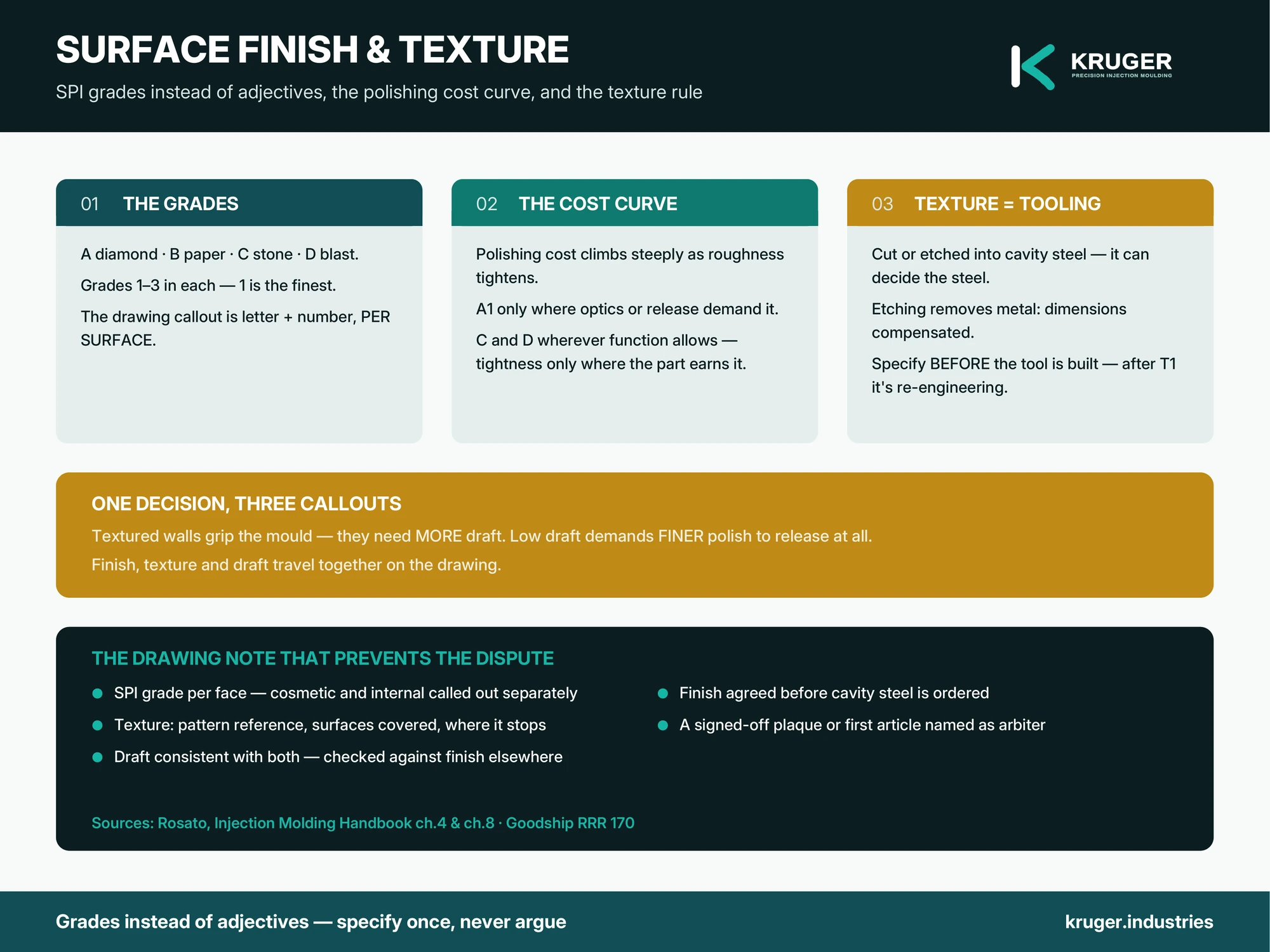
For years finish was specified in qualitative terms — dull, satin, shiny — and the older standards handled it badly enough that the industry replaced them. The current SPI mould-finish grades put every finish in a two-character grid: category A is diamond polish (the optical end), B is paper finish, C is stone finish, D is blast (matte); each category carries grades 1 to 3, with 1 the finest (Rosato). So “A1” is the mirror a lens demands, “C2” is an honest workaday internal face, and “D2” is a uniform matte. The callout on the drawing is that letter-number, per surface — cosmetic faces named, internal faces named, because they should not carry the same grade.
Polish is bought on a curve
The standard grades only the final step — polishing — and the handbook plots what that step costs: polishing cost rises steeply as the roughness target tightens (Rosato, Fig. 4-129). The grades exist precisely so you can buy less polish where less is enough. Every grade above what a surface functionally needs is money spent on faces no customer sees, and mirror finishes carry a second, quieter cost: the finer the finish, the more visible every fingerprint, weld line and wear mark becomes in service. The discipline is the same one the tolerances guide teaches — spend tightness only where the part earns it. A1 where optics or release demand it; C and D everywhere the function allows.
Texture is cut into steel, not sprayed on later
Texturing means creating a pattern in the mould cavity surface — by cutting, or by controlled chemical etching — that reproduces on every part (Rosato). It began as a repair tactic, masking flow lines and sink marks, and grew into a design feature; but it remains a tooling decision with tooling consequences. The texture choice can dictate which cavity steel is used; etching removes metal, so cavity dimensions may need compensating; and hand-applied processes need access — restricted areas, knife-edges and cams have to be discussed while the mould is being designed (Rosato). The practical rule for a buyer: specify texture before the tool is built. A texture added after first trials is a re-engineering exercise, not a touch-up.
Texture and draft are one decision
The two-way trade our DFM guide states from the draft side applies here from the finish side. Textured walls grip the mould, so they need more draft than polished ones; and the lower the draft, the finer the polish must be for the part to release at all. Finish, texture and draft are therefore one decision wearing three callouts — and the draft-angle calculator will convert whatever angle survives the discussion into millimetres for your part height.
Gloss still belongs to the process
One caution to complete the picture: a correctly finished tool does not guarantee a correct-looking part. Gloss differences are their own defect class in the troubleshooting literature — surface appearance moves with melt and mould temperature even when the steel is right (the defects guide covers the families). Finish specification controls the tool; process discipline delivers it, shot after shot.
The drawing note that prevents the dispute
- SPI grade per surface — cosmetic faces and internal faces called out separately, never one grade for the whole part.
- Texture: pattern reference, the surfaces it covers, and exactly where it stops.
- Draft consistent with both — more for texture, checked against the finish on the untextured faces.
- Finish agreed before cavity steel is ordered — texture can decide the steel.
- A signed-off reference — plaque or approved first article — named as the arbiter for appearance questions.
Put the grade on the drawing
Send the CAD with the finish callouts you have — or without them, and say so. The DFM reply will propose grades per surface, flag where texture wants more draft, and price the difference plainly. Request a quote; an engineer replies within 48 hours on working days.